

Study in France for Moroccan students
Campus International guides you through choosing your university and programme, your admission and scholarship file, your visa application and a confident departure.
- Recognised universities
- Visa file support
- Ongoing support
Our students in France, on video
A testimonial from one of our students in France
 By the Campus International advisors
Updated
9 min read
Guide contents 13 sections
- Studying in France: an ideal destination to continue your higher education
- The education system in France for Moroccans
- Higher education in France is based on a clear, well-organised structure called the LMD system, which stands for
- Language of instruction and the advantage of the Moroccan profile
- Tuition fees for studying in France by type of institution
- The cost of studying in France varies depending on the type of institution, but remains affordable overall compared with other European countries. There are options to suit every budget, whether through public universities, private schools or work-study programmes (Alternance).
- Job opportunities while studying in France for Moroccans
- One of the most important advantages for international students in France is the possibility of working legally during their studies, which helps reduce living costs while gaining valuable professional experience.
- Admission requirements and visa procedures for studying in France
- The best university cities in France for Moroccans
- Advantages of studying in France for Moroccans
- France is more than just an academic destination: it offers an all-round experience, combining quality teaching, cultural richness and solid career prospects. This is what makes it a preferred choice for Moroccan students.
- Frequently asked questions about studying in France
Studying in France: an ideal destination to continue your higher education
For several decades, France has remained one of the most popular destinations for Moroccan students.
It appeals through the high quality of its teaching, the diversity of its programmes and the widespread use of the French language, which makes it much easier for students from Morocco to adapt.
What makes France even more attractive is its geographical and cultural proximity to Morocco. It offers a structured academic environment while remaining close to Moroccan values and habits.
French universities rank among the best in the world and offer real opportunities for academic success, as well as internship and job opportunities that let you build a solid career path.
France is not just a study destination; it is a complete experience, combining prestigious teaching, a lively university life and career prospects in Europe and internationally.
The education system in France for Moroccans
Higher education in France is based on a clear, well-organised structure called the LMD system, which stands for
- Licence (Bachelor’s degree): 3 years of study after the baccalaureate
- Master: 2 years after the Licence
- Doctorat (PhD): 3 to 4 years after the Master
This system is harmonised at European level, which makes student mobility and continuing your studies in other EU countries easier.
Public universities
They offer solid theoretical programmes at very low fees, ranging from 170 to 380 euros per year.
However, some fields such as medicine or engineering require high grades and sometimes a competitive exam or an interview for admission.
Grandes Écoles and specialised institutes
They focus on fields such as business, engineering, media or political science, and are strongly connected to the job market.
Private institutions
These include schools of business, technology, design or fine arts, with highly career-oriented programmes but higher annual fees, between 5,000 and 10,000 euros on average.
Whatever the type of institution, French degrees are recognised internationally and open the door to many academic and professional opportunities in France, in Europe and in Morocco.
Language of instruction and the advantage of the Moroccan profile
One of the great advantages for Moroccan students in France is the language of instruction: most programmes are taught in French, which makes adapting considerably easier.
An undeniable language advantage
Having studied in French from secondary school onwards, Moroccan students already master the language, which gives them a clear head start in understanding lectures, taking part in discussions and passing exams without a language barrier.
Easier academic integration
Thanks to this language background, no long period of language preparation is needed. You can join classes directly from the first semester and make the most of your results.
Programmes in English too
Although French is dominant, more and more Master’s and doctoral programmes are offered in English, particularly in science, management and technology. This broadens the prospects for students who want a more international education.
This command of French, combined with an already familiar academic culture, allows Moroccan students to stand out naturally during their university studies in France.
Tuition fees for studying in France by type of institution
The cost of studying in France varies depending on the type of institution, but remains affordable overall compared with other European countries. There are options to suit every budget, whether through public universities, private schools or work-study programmes (Alternance).
Public universities
The French state heavily subsidises higher education, which keeps registration fees at a symbolic level:
- €170 per year for the Bachelor’s degree (baccalaureate + 3)
- €250 per year for the Master’s (baccalaureate + 5)
- €380 per year for the Doctorate (baccalaureate + 8)
Some selective fields such as medicine, pharmacy or engineering may require a high academic level and a stricter selection process.
Private schools and institutes
They offer highly sought-after, career-oriented programmes in fields such as:
- Business
- Media
- Applied arts
- Technology
- Design
Annual fees are generally between €5,000 and €10,000, depending on the field of study, the level and the reputation of the institution.
Alternance (work-study programmes)
This system is one of the best options for students who want to study while working:
- You alternate between classes at school and work in a company
- You receive a monthly salary
- Tuition fees are fully covered by the company
Alternance therefore lets you study for free, earn an income and build valuable professional experience, offering a natural transition into employment after graduation.
Job opportunities while studying in France for Moroccans
One of the most important advantages for international students in France is the possibility of working legally during their studies, which helps reduce living costs while gaining valuable professional experience.
Part-time work allowed
International students are allowed to work up to 20 hours per week during the academic year, and full time during the school holidays.
- Pay varies depending on the type of job, but a student can generally earn between €300 and €600 per month, depending on the city and the sector.
- Most student jobs are in restaurants and catering, in shopping centres, or as assistants on university campuses.
Compulsory internships (work placements)
Some programmes, particularly in grandes écoles or specialised institutes, require you to complete an internship in a company as part of the course.
- These internships provide direct hands-on experience and considerably strengthen a graduate’s CV.
- Many internships are paid, particularly long-term ones or those in technical and management fields.
By combining studies with a student job, Moroccan students can partly support themselves while developing their skills in a European professional setting.
Admission requirements and visa procedures for studying in France
To study in France, Moroccan students must put together a strong application file and follow a well-defined administrative process, notably through the official Campus France platform and the TLScontact application centre.
At Campus International, we support every student at every stage to ensure a complete file that meets consular requirements.
Required documents
- French language certificate (TCF B1 or B2) depending on the chosen field
- Proof of funds: a minimum of €8,000 must be available in a bank account
- Financial guarantee: a person who can prove a stable income to support the student
- Organised academic file: diplomas, transcripts, motivation letter, CV, study plan
- Letter of admission from a recognised institution in France
Administrative steps
- Creating an account on the Campus France platform and entering your information
- Preparing the complete paper file, with all supporting documents
- Submitting the application to TLScontact on the agreed date
With our personalised support, we manage the entire process: collecting documents, checking the file, filling in forms and booking appointments, right through to obtaining your student visa securely.
The best university cities in France for Moroccans
France has many renowned student cities, combining academic excellence, a diversity of institutions and quality of student life. Your choice of city plays an important role in the success of your university experience, particularly in terms of cost, atmosphere and career opportunities.
The cities most popular with Moroccan students:
- Paris: the cultural and academic capital, home to the most prestigious universities, but still the most expensive in terms of housing and daily life.
- Lyon: a recognised university hub with an excellent balance between quality of teaching and a moderate cost of living.
- Toulouse: specialising in aeronautics and engineering, it attracts many international students with its dynamic environment.
- Lille: close to Belgium, it is known for its friendly setting, its higher education schools and its private universities.
- Bordeaux: an attractive city, particularly in the fields of management, the arts and the sciences.
- Nantes, Montpellier, Strasbourg: medium-sized cities with an excellent academic level, a rich student life and reasonable living costs.
At Campus International, we advise every student on choosing their city, taking into account their budget, the programme they want and the lifestyle they are looking for, to ensure the best possible study experience.
Advantages of studying in France for Moroccans
France is more than just an academic destination: it offers an all-round experience, combining quality teaching, cultural richness and solid career prospects. This is what makes it a preferred choice for Moroccan students.
- World-recognised higher education
French universities and grandes écoles offer rigorous academic programmes. Their degrees are recognised in Morocco and internationally, opening the way to many opportunities for employment or further study. - A familiar language of study
Because French is the language of instruction, Moroccan students find themselves in a familiar linguistic environment, which makes it easier to integrate and succeed from the very first semester. - Access to work and internships
Students can legally work 20 hours/week during their studies and access compulsory internships in several fields, adding real professional experience to their academic path. - A wide range of study options
Between low-cost public universities, selective grandes écoles, private institutions and Alternance (study + work), every type of student can find an option that suits them. - Geographical and cultural proximity to Morocco
France remains a nearby country, both geographically and culturally, which makes it easier to adapt quickly and keep your social and family bearings. - A strong Moroccan community
French university cities are home to a large Moroccan diaspora, forming a supportive network for newcomers. - Possibility of settling professionally after your studies
Many Moroccan students convert their student visa into a work permit after graduating, particularly in sectors facing labour shortages.
These strengths make France a strategic and complete destination for any Moroccan student wishing to build an academic and professional future in Europe.
Frequently asked questions about studying in France
01 Can I study in France without a French language certificate?
Moroccan students are usually required to provide a French language certificate such as the TCF or DELF B2, especially when applying to public universities. However, some private institutions may accept students without a language certificate, provided they pass an internal test or provide proof of language proficiency.
02 What is the minimum amount required in a bank account to obtain a student visa?
Students must prove that they have at least €8,000 available in a bank account to cover their annual living costs in France.
03 Can I work while studying in France?
Yes, international students are allowed to work part time up to 20 hours per week during their studies, and full time during the holidays.
04 Are French degrees recognised in Morocco?
Yes, degrees issued by French universities and institutes are recognised in Morocco, especially if they come from accredited institutions.
05 Can I apply to more than one university or school at the same time?
Yes. Through Campus International, we take care of applying for you to several schools or universities at the same time, depending on the field that suits you, to increase your chances of admission and ensure the best choice.
06 What are the main steps to obtain a student visa?
The steps include: obtaining university admission, applying through the Campus France platform, gathering the required documents and submitting your file at the TLScontact centre on the scheduled date.
07 How long does it take to get university admission?
The time varies depending on the institution and the field of study, but it usually ranges from two weeks to a month from the date you submit your complete file.
08 Can I convert my student visa into a work residence permit after graduating?
Yes. After graduating, students can apply for a residence permit to work, especially if they have received a job offer in their field of study.
Articles about studying in France
All articles-
 France
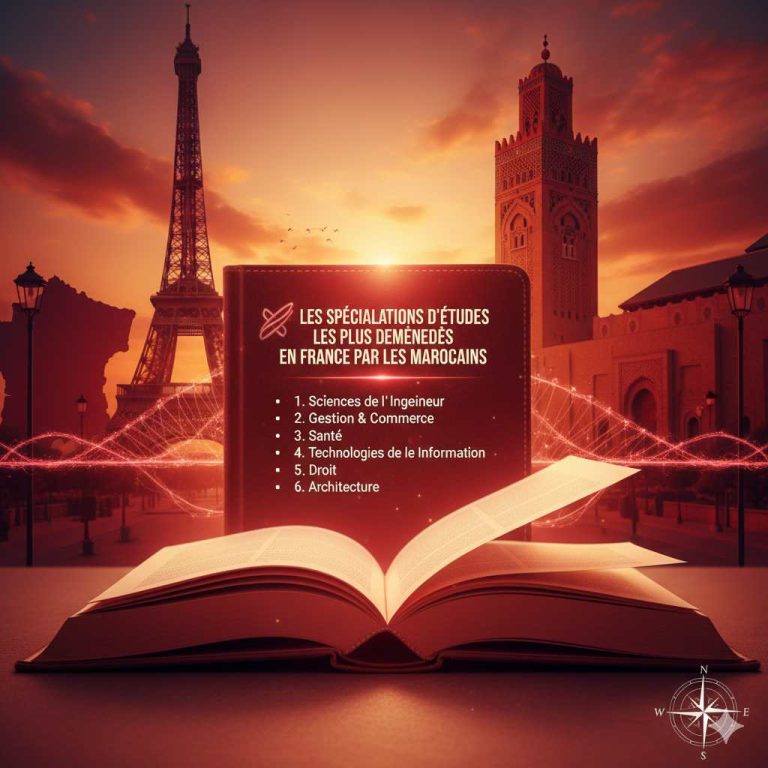
Les Spécialisations d’Études les Plus Demandées en France par les Marocains
La France est l’une des destinations éducatives les plus prisées par les étudiants marocains, compte tenu de l’excellence de son…
-
 France
Avantages d’étudier en France pour les Marocains
Étudier en France, c’est bien plus qu’une simple expérience académique : c’est une véritable opportunité de croissance personnelle et professionnelle.…
-
 France
Le système de formation en alternance en France
Découvrez l’opportunité unique qu’offre le système d’alternance en France, une formule qui combine formation académique et expérience professionnelle concrète. Grâce…
Let's find your best path abroad.
Complete this free assessment. A Campus International counselor will contact you within one working day.
- Free initial assessment
- No commitment required
- Your data stays private